
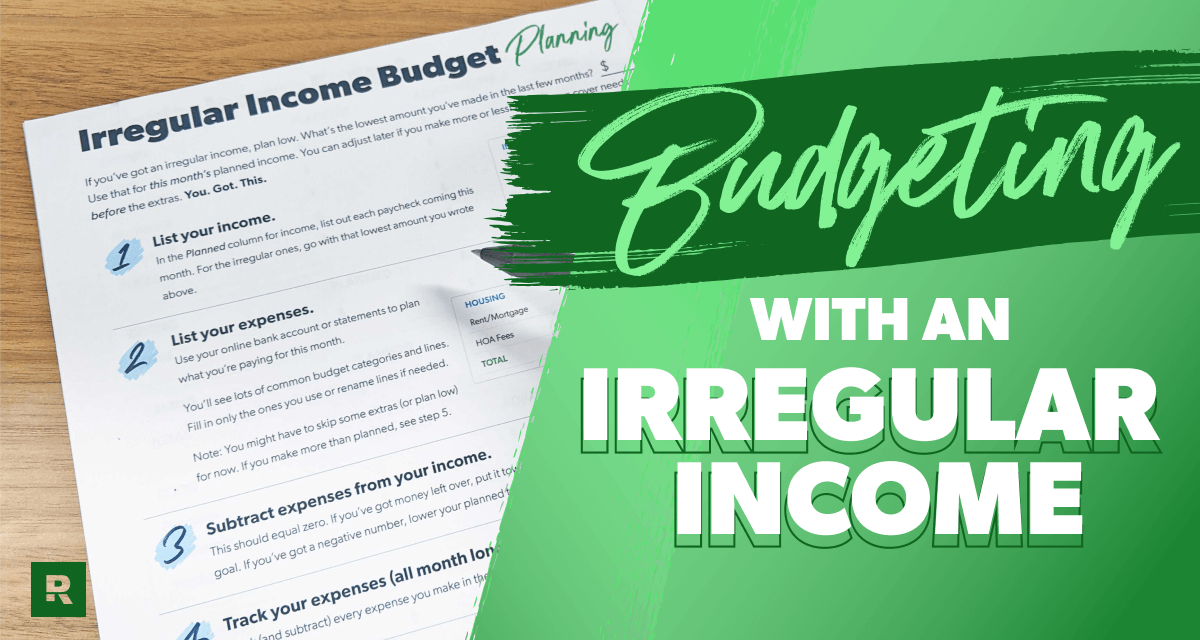
Gain control and peace of mind by implementing a budget system designed for income variability
If your income resembles a rollercoaster more than a straight line, you're not alone. Millions of freelancers, gig workers, commissioned salespeople, and seasonal workers navigate the unique challenge of budgeting without a steady paycheck. The stress of not knowing when or how much you'll get paid can be overwhelming, but it doesn't have to dictate your financial life.
The secret isn't predicting the unpredictable—it's building a flexible system that works with your income's natural ebb and flow. By shifting your focus from forecasting future income to strategically managing the money you have now, you can create remarkable stability.
Does This Sound Like You?
Irregular income isn't one-size-fits-all. It often varies in two key ways: the amount you're paid and the timing of your payments. Here are some common scenarios:
-
The Freelancer or Contractor
Your workload comes in waves. You might juggle multiple projects one month ("feast") and face a dry spell the next ("famine"). Income is tied to project completion and client payments, which are often delayed.
-
The Commission-Based Worker
Common in sales and real estate, your earnings peak during busy seasons and plummet during slow periods. The challenge is managing high expenses that don't pause when commissions dip.
-
The Seasonal or Gig Worker
Teachers with unpaid summers, holiday retail workers, or ride-share drivers fall into this category. Income is predictable in its pattern but requires saving during peak times to cover off-seasons.
The Core Mindset Shift: Stop Forecasting, Start Managing
The biggest mistake people with irregular income make is forecasting—budgeting with money they hope or expect to receive in the future. This creates a false sense of security and often leads to overspending.
"Forecasting is planning ahead with monthly income that you think will arrive before the money actually arrives... It can result in a false feeling of financial control."
Instead, adopt this empowering principle: Only budget the money you actually have in your possession right now. This forces clarity, prioritization, and prevents the anxiety of counting on uncertain funds. Your budget becomes a flexible tool you adjust as income arrives, not a rigid plan built on hopes.
The Step-by-Step Budgeting System for Irregular Income
Step 1: Know Your Baseline - Calculate Essentials
Before you can manage variability, you need rock-solid clarity on your non-negotiable expenses. This is your financial bedrock.
Priority Guide: When income is variable, the order in which you cover expenses is critical. Always fund these categories in this sequence:
The "Four Walls" - Absolute Essentials
These are survival needs. Nothing else gets funded until these are secure.
- Food: Groceries for basic nutrition at home.
- Utilities: Water, electricity, heat—keeping the lights on.
- Shelter: Rent or mortgage payment.
- Transportation: Fuel, public transit, or car payment to get to work.
Other Essential Obligations
Once the Four Walls are covered, address these critical commitments.
- Insurance: Health, auto, and renters/homeowners insurance.
- Minimum Debt Payments: Avoid penalties and protect your credit.
- Childcare: Essential for working parents.
- Taxes (for self-employed): Set aside to avoid a large annual bill.
True Savings & Debt Elimination
This is where you build stability and wealth.
- Emergency Fund: Your financial shock absorber (aim for 3-6 months of expenses).
- Extra Debt Payments: Attack principal to become debt-free faster.
- Retirement Savings: Crucial when you don't have an employer-sponsored plan.
Non-Essential & Quality of Life
These are the "wants." They are funded only after all other priorities are met.
- Dining Out & Entertainment: Restaurants, movies, subscriptions.
- Personal Spending: Hobbies, clothing beyond basics.
- Gifts & Travel: These are planned-for luxuries, not emergencies.
Step 2: Implement the "Pay Yourself a Salary" System
This is the game-changer for smoothing out income volatility. The goal is to create a consistent, predictable "salary" you live on each month, regardless of what hits your bank account.
The "Boom and Bust" Fund System
Financial planner Antowoine Winters and freelancer Holly Johnson recommend this method to eliminate the feast-or-famine cycle.
Calculate Your Monthly "Salary"
Add up your total monthly essentials from Step 1 (Four Walls + Other Essentials). Let's say that equals $4,000. This is your target monthly salary.
Divert All Income to a Holding Account
Have all client payments, gig money, etc., deposited into one main account. This is your "income reservoir".
Pay Your Salary & Manage the Surplus
On the 1st of each month, transfer exactly $4,000 to your checking account for bills and spending. Any extra money that came in stays in the reservoir as your "Boom and Bust" fund.
How it works: In a "boom" month where you earn $6,000, you pay your $4,000 salary and save $2,000. In a "bust" month where you earn only $3,000, you pay your $4,000 salary by pulling $1,000 from your saved surplus. Your lifestyle and bill payments never change.
Step 3: Build Your Financial Safety Nets (The Three Critical Funds)
With irregular income, savings aren't just for the future—they're an operational necessity for present-day stability. You need to compartmentalize your savings into specific funds.
Your Three Must-Have Funds
1. The Emergency Fund
Purpose: True emergencies—unexpected medical bills, urgent car repairs, or surviving a complete loss of income.
Target: 3-6 months of essential expenses (from Tier 1 & 2). Those with very unpredictable income may aim for up to a year's worth for greater peace of mind.
Rule: Do not touch for non-emergencies. Replenish immediately if used.
2. The "Boom & Bust" Fund (Income Smoothing)
Purpose: The operational fund for your "salary" system above. It smooths out monthly income gaps.
Target: Ideally 1-2 months of your set "salary." This is your buffer to ensure you can always pay yourself.
Rule: Actively managed monthly. It will grow and shrink—that's its job.
3. The Tax Fund (For Self-Employed)
Purpose: To pay quarterly estimated taxes and your annual tax bill. Since taxes aren't withheld from your pay, you must do it yourself.
Target: 25-30% of every single payment you receive should be moved here immediately.
Rule: Never consider this money yours to spend. It belongs to the government.
Step 4: Execute the Month-to-Month Plan
This is your actionable checklist for each pay period and each month. Consistency with this process is what builds unshakeable financial control.
Your Irregular Income Budgeting Cycle
-
When Money Arrives (Every Paycheck)
Action: Immediately allocate it using the priority order from Step 1.
What to do: 1) Cover any remaining essentials for the month. 2) Boost your Emergency Fund towards its goal. 3) Top up your "Boom & Bust" fund. 4) If all else is covered, you can finally fund non-essentials or make extra debt payments.
-
Before the New Month Begins
Action: Create a zero-based budget for the coming month using only the money currently in your "Boom & Bust" fund and expected, guaranteed income.
Give every dollar a job until your available money equals zero. Remember: if the money isn't in your account, don't budget it. It's better to start with a conservative plan and add categories later if more money comes in.
-
Throughout the Month
Action: Track every expense against your budget.
Use an app, spreadsheet, or notebook. This real-time tracking prevents overspending and shows you exactly where you stand. If you overspend in one category, you must reduce another category to keep your budget at zero.
Essential Tools & Tips for Success
Use Separate Bank Accounts: Physically separate your money based on its job. Have one account for your "salary" checking, one for your "Boom & Bust" fund, and separate savings accounts for Emergency and Tax funds. This reduces temptation and creates clarity.
Budget Based on Your Lowest Monthly Income: When planning your essential spending, use the lowest amount you've earned in the past 6-12 months as your baseline. This conservative approach guarantees you can always cover necessities. Any income above that baseline is surplus to be allocated to savings or non-essentials.
Embrace Imperfection and Adjust: Your first few budgets will be guesses. You'll forget expenses and mis-category spending. That's normal. The key is to track what happened, learn from it, and adjust next month's plan. Budgeting is a skill that improves with practice.
The Path to Financial Peace
Budgeting on an irregular income isn't about achieving perfect prediction; it's about implementing a resilient system. By focusing on the money you have, prioritizing ruthlessly, and using the "salary" and dedicated fund system, you transform financial volatility from a source of stress into a manageable variable.
Start today. Calculate your essential expenses. Open a separate savings account for your "Boom & Bust" fund. Make your first zero-based budget with the cash currently available. With each month, you'll gain more confidence and control, replacing anxiety with the profound peace that comes from knowing you have a plan for every dollar, no matter when it arrives.