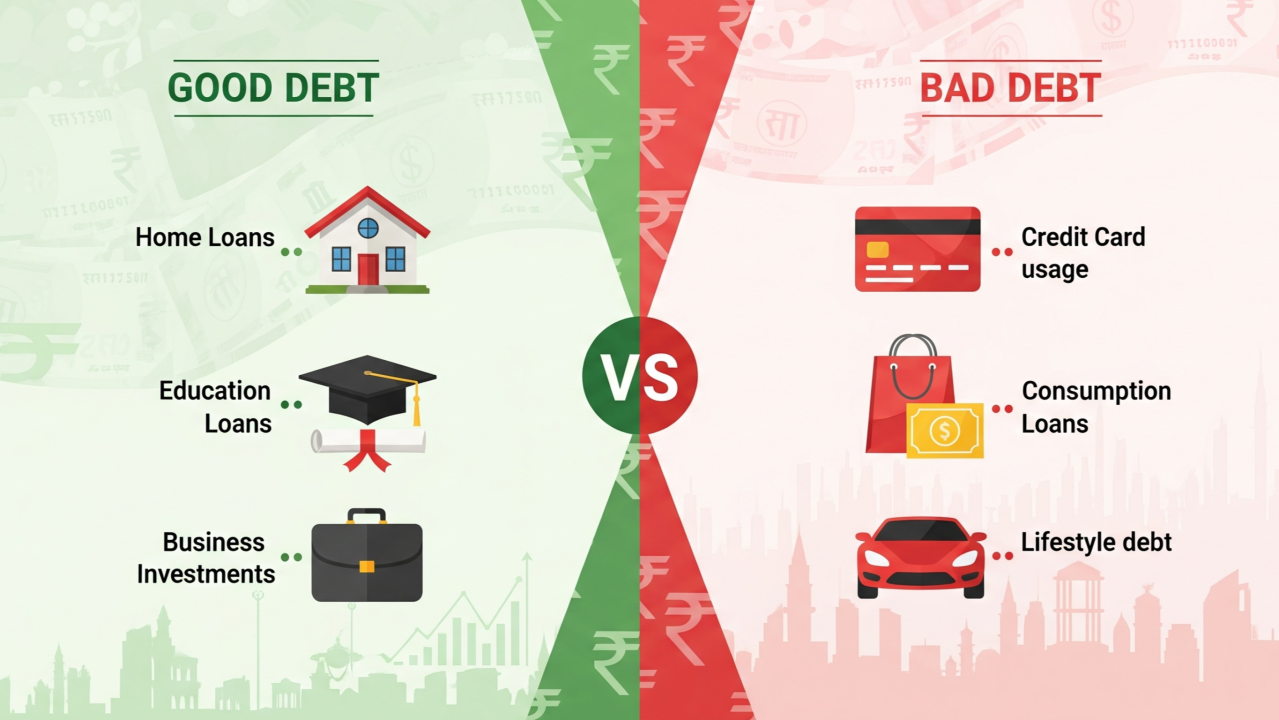
Good debt helps your wealth grow, while bad debt melts your financial resources away.
With U.S. household debt surpassing $17.69 trillion, understanding debt is more critical than ever . The common perception is that all debt is harmful—a necessary evil at best. But this black-and-white view can be misleading and costly. In reality, debt is a financial tool. Like any tool, it can be used skillfully to build something valuable or carelessly to cause damage. The key is knowing the difference between "good debt" and "bad debt" .
This isn't just semantics. As David Mook, a senior vice president at U.S. Bank, explains, "Good debt can help borrowers accomplish an objective... Bad debt is borrowing to support ongoing living expenses" . Let's break down what this means for your finances.
Debt: A Financial Tool, Not a Foe
The outcome depends entirely on what you're building and the terms of your loan.
The Fundamental Difference: Investment vs. Consumption
At its core, the distinction is about what the debt is used for and its long-term financial impact.
What is GOOD Debt?
Good debt is money borrowed to acquire something that increases in value over time or generates future income . It's an investment in your financial future. Experts often note it typically comes with a lower interest rate (APR), generally considered to be under 6% .
The Core Principle: The asset or benefit you gain is worth more than the cost of the debt.
What is BAD Debt?
Bad debt is money borrowed to purchase things that quickly lose value (depreciate) or are consumed immediately . It often comes with a high interest rate (APR of 6% or higher) and provides no lasting financial benefit .
The Core Problem: You're paying interest, often at a high rate, for something that provides no return and is gone.
Common Examples: From Clear-Cut to Gray Areas
Prime Examples of GOOD Debt
Common Examples of BAD Debt
The Gray Area: It's Not Always Black and White
Some debts don't fit neatly into "good" or "bad." Their classification depends heavily on your specific circumstances, the terms, and your behavior .
Auto Loans
Can be gray. A reasonable loan for a reliable car you need for work is different from a high-interest loan for a luxury vehicle. An auto loan can be good if it enables income , but bad if the car depreciates rapidly .
Buy Now, Pay Later (BNPL)
Can be gray. Interest-free BNPL for a planned purchase is fine. Using multiple BNPL plans for things you can't afford leads to trouble .
Credit Cards (if paid in full)
Can be good. If you pay the balance in full every month, you pay no interest. This builds credit history and can earn rewards, making it a useful financial tool .
The Power of Good Debt: Understanding Financial Leverage
This is where "good debt" becomes a strategic superpower. Financial leverage is using borrowed money to potentially increase the return on an investment .
How Leverage Works
Imagine investing $50 of your own money and borrowing $50 at a 5% interest rate. If your $100 investment grows 10% ($10), your return on your own $50 is 20% ($10 gain minus ~$2.50 interest = $7.50 net / $50 = 15%). You've amplified your return by using "good debt" .
Real-World Leverage Examples:
- A Mortgage: You put 20% down on a home. If the home's value increases, that gain is calculated on the total home value, not just your down payment.
- A Business Loan: Borrowing to buy equipment that allows your business to serve more clients and multiply profits.
- Liquid Asset Financing: Borrowing against your investment portfolio at a low rate to seize an opportunity without selling assets and incurring taxes .
As David Mook advises, "You don't want to be overleveraged... but leverage in moderation can be a really powerful tool" .
Warning: When Good Debt Turns Bad
Even the best debt can become a burden if mismanaged. Good debt turns bad when :
- You borrow too much: Even a low-rate mortgage is bad if the payment consumes 40%+ of your income .
- Your situation changes: Job loss or illness can make any debt unaffordable.
- The investment fails: Your business doesn't take off, or the housing market dips.
- You misuse it: Using a home equity loan for a vacation instead of home improvement.
Your Decision Matrix: Is This Debt Good or Bad?
Before you borrow, run through these key questions. Your honest answers will guide you.
The 4 Questions to Ask Before Borrowing
Action Plan: Managing the Debt You Have
If you have a mix of debts, prioritize repayment strategically. The goal is to minimize total interest and free up cash flow.
HIGH PRIORITY
Attack Bad Debt First. Focus on high-interest debt (credit cards, payday loans). Use the avalanche method (highest rate first) to save the most money .
MEDIUM PRIORITY
Manage Gray-Area Debt. Maintain payments on auto or personal loans. Consider refinancing if rates have dropped.
LOW PRIORITY
Maintain Good Debt. Keep making regular payments on low-rate mortgages and student loans. There's no need to rush these if the rate is favorable and you're investing elsewhere.
The Final Word: Borrow with Purpose
Debt itself is neither inherently good nor bad. It's a neutral financial instrument. What makes debt "good" or "bad" is how you use it .
Good debt is a calculated, purposeful investment in your future earning power or assets. Bad debt is expensive financing for fleeting consumption. By understanding this core difference, asking the right questions before you borrow, and prioritizing repayment of costly debt, you transform debt from a source of stress into a strategic tool for building lasting wealth.